Long hours sitting? Back posture supports, everyday habits and what really helps
· Guides by SG
Part of Health & Wellness Guides

The workday ends, but your back still feels as if it is at the desk. Perhaps you move from a commute into meetings, then into studying or another screen at home. You notice yourself folding forward, straighten up briefly, and soon return to the same position. The question is not how to hold a perfect pose forever. It is how to make a long seated routine less static and easier to manage.
At Rosedrick & Co, we position the VBOSi Back Posture Corrector Model 2002 as an optional sitting-position reminder. This guide looks at everyday back habits, the implications for work and health, and the role a longer-panel support can realistically play.

Why “just sit up” rarely solves the whole problem
A seat without comfortable support, a low screen, a keyboard placed off-centre and long uninterrupted tasks can all make your working position harder to vary. On busy days, comfort checks become the thing you postpone. The same pattern may continue during gaming, homework or evening phone use.
There is a difference between wanting a prompt to notice those habits and needing treatment for back pain. A wearable can offer contact you notice. It cannot establish why your back hurts, assess a nerve problem or adapt an unsuitable desk for you.

Back pain is real, but posture is not the whole explanation
Low back pain can interfere with movement, everyday activities, work and mental wellbeing. That deserves attention. But the factors involved can be physical, psychological and social; a curved sitting position alone does not explain everyone's symptoms.
Ordinary changes of position should not be treated as a threat to a fragile spine. Looking more upright does not prove that pain has been prevented, and pain intensity does not provide a simple measurement of tissue damage. Persistent or recurrent symptoms deserve individual assessment rather than an online posture diagnosis.
Our recommendation is to improve the everyday environment and keep movement in the picture, while recognising when self-management is not enough. Buying a larger support is not the same as receiving more appropriate care.
Long-term effects that are easy to overlook
The long-term concern we can support is the amount of sedentary time across your life, not a claim that every hour of slouching permanently deforms your back. Commuting, desk work and evening screen time can leave little room for movement even when each part feels normal.
Higher sedentary time is associated with increased risks including cardiovascular disease and type 2 diabetes. Those are associations with low-activity patterns, not evidence that your sitting angle causes those illnesses. A back support does not offset sedentary time, replace physical activity or prevent those conditions.
Another useful issue to notice is whether pain is increasingly limiting participation: avoiding walks, cutting activities short or struggling to work. That is a reason to seek support, not evidence that you need to tighten a brace. Address the pattern early through appropriate advice instead of waiting for a wearable to correct it.
The work and productivity implications
Back discomfort can make a workday harder to manage, and back pain can affect participation in work. Those consequences matter whether you are employed, self-employed or studying. They do not establish that a posture corrector will reduce sick days, improve memory or make you work faster.
Research on specific work-break schedules and productivity remains uncertain. At Rosedrick & Co, we do not promise output improvements or guaranteed pain relief. A realistic aim for an optional support is to make you more aware of a seated habit so you can respond, rather than tolerate an uncomfortable setup for longer.
Build the solution around the day, not just the chair

- Support a comfortable starting position. Adjust the chair so your back and feet are supported. Keep the screen and keyboard central rather than twisting to work.
- Make laptop work adjustable. A separate keyboard and mouse allow the screen to be raised while your hands remain at a comfortable level.
- Vary tasks and positions. Use transitions between calls, pages or tasks to change position or take a short walk when practical. Neither standing motionless nor sitting rigidly all day is the goal.
- Keep meaningful activity in your week. Everyday walking and other suitable activity matter beyond the desk. Build gradually and seek tailored advice if symptoms affect what you can do.
- Notice when you need more help. If pain persists, worsens or limits your normal activities, consult a qualified healthcare professional rather than relying on a support alone.

What the VBOSi Back Posture Corrector 2002 offers
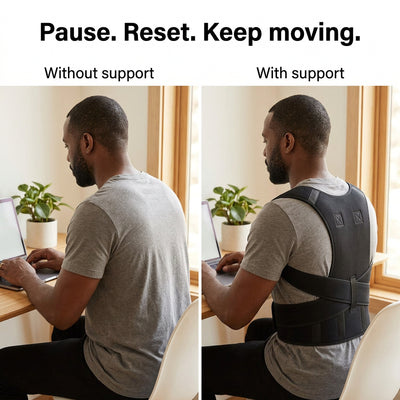
The Model 2002 combines shoulder sections, a longer back panel extending towards the waist and adjustable waist fastening. Those are its practical distinctions from the shoulder-focused 2001. The wrap secures the fit; extended coverage is not proof of spinal stabilisation or lumbar treatment.
It may suit a person who wants a broader contact cue during desk work or studying. When you notice the support, use that moment to check your seat, reposition comfortably and consider a movement break. The aim is awareness, not being held rigidly in one shape.

View the VBOSi Back Posture Corrector 2002 for its sizes, materials and fitting information.
What research does not justify promising
Evidence on wearable posture aids varies by device, study population and outcome. Changes in a posture measurement are not the same as lasting pain relief, injury prevention or improved productivity. Findings from a different support cannot be transferred to this model. We have not clinically tested the VBOSi 2002.
Clinical guidance for chronic primary low back pain advises against routinely using lumbar braces, belts or supports as treatment. That recommendation concerns a defined pain condition and is not a trial of this particular product. It reinforces why we offer the 2002 as an optional awareness tool rather than a chronic-pain solution.
Do not buy it expecting a cure for sciatica, scoliosis, a slipped disc or another diagnosed condition. A clinician's recommendation for an individual medical support is a different situation and should guide your choice.
Fit and use without forcing your body
Follow the supplied instructions and choose from the manufacturer's measurements, not your usual clothing size alone. Centre the support across your back, fasten it comfortably and keep breathing and movement unrestricted. Do not tighten it until your body is forced into a position, and do not prescribe yourself all-day wear because a task is long.
The listed materials are 47% polyester, 36% rubber, 14% nylon and 3% spandex. Stop use for irritation, numbness, tingling or increased discomfort. Ask a qualified professional before use if you have a recent injury, an existing back or shoulder condition or persistent pain. There is no universal wear-duration rule we can substantiate for this product; follow its instructions and individual advice.
When a support is not the next step
Seek urgent medical help for back pain accompanied by new bladder or bowel changes, numbness around the genitals or anus, weakness or numbness in both legs, chest pain, or pain following a serious accident. Sudden severe or rapidly worsening pain, or back pain with fever or feeling unwell, also needs prompt assessment. Do not try to manage those signs by wearing or tightening a corrector.
Choose the right everyday reminder
The 2002 suits someone seeking shoulder-and-back contact with a longer panel and waist wrap. If you mainly want a shoulder-focused cue, view the VBOSi Shoulder Posture Corrector 2001 and read its screen-work guide. We do not rank one as medically stronger: the difference is design and coverage.
Our value offer at Rosedrick & Co is a clear choice, honest expectations and a practical routine around the product. Shop the back posture reminder if that is what you need, and keep your workspace, movement and appropriate healthcare at the centre of the solution.
Sources and further reading
Research and public-health guidance informing this guide. Studies of other supports do not establish the performance of the VBOSi products sold by Rosedrick & Co.
- Low back pain: effects on function, wellbeing and participation
- Clinical recommendations: lumbar braces and chronic primary low back pain
- Physical activity and sedentary behaviour
- Computer and laptop workstation guidance
- Work-break interventions: Cochrane evidence review
- Short-term scapular brace trial: device-specific evidence limits
- Back pain: self-care and urgent warning signs
Shop the solution
What we recommend for this
The practical pieces that fit the routine in this guide. Choose what fills a real gap for you.