Rounded upper back or kyphosis? What to know before choosing support
· Guides by SG
Part of Health & Wellness Guides

In short
A rounded upper back can come from very different places. For many people it is a flexible habit built over long days at a laptop, a steering wheel or a pile of textbooks. For others it is a structural curve, such as Scheuermann's kyphosis, where the shape of the spinal bones themselves has changed. Targeted, supervised exercise can improve strength, mobility and comfort, and in research it has reduced measured curvature in some older adults. A retail posture corrector is a helpful reminder, not a treatment for a structural curve. If your back shape is changing or symptoms persist, the right first step is an assessment, not a tighter strap.
Who this guide is for
You may have caught your reflection in a shop window, seen a side-on photo from a family braai or noticed that your shoulders feel permanently "forward" after a week of deadlines. This guide is for adults who want to understand what a rounded upper back means before choosing a support or a routine, and for anyone helping a parent or partner make sense of the options.
Our aim is to match the next step to the need. Sometimes that is a better screen setup. Sometimes it is a physiotherapy appointment. Children and teenagers with a visible curve need an age-appropriate assessment rather than an adult routine.
Kyphosis is not simply another word for slouching
Your upper back naturally curves outwards. Kyphosis is the clinical term for when that curve becomes excessive. Rounded shoulders, a forward head and leaning over a laptop often appear together, but they are not the same thing as a diagnosed curve.
- Postural kyphosis is usually flexible and linked to habitual positions.
- Scheuermann's kyphosis develops during growth, when some vertebrae (the bones of the spine) become wedge-shaped.
- Congenital kyphosis relates to how the spine developed before birth.
- Fractures and age-related change also matter, especially when a curve appears alongside height loss or a sudden change in symptoms.
Telling these apart takes a clinician's history and examination. Pressing yourself flat against a wall or asking someone to pull your shoulders back will not reveal the cause, and being able to stand straighter for a moment does not rule an underlying condition in or out.
What exercise research shows
Wendy Katzman, a physical therapist and professor emeritus at the University of California, San Francisco, has spent years studying targeted exercise for hyperkyphosis (an excessive upper-back curve). In the SHEAF (Study of Hyperkyphosis, Exercise and Function) trial, 99 adults aged 60 and over were compared over six months. The exercise group attended one-hour, physiotherapist-led sessions three times a week.
That group improved their measured spinal curve by about three degrees more than the comparison group. It is a meaningful result: a structured, supervised programme changed the curve itself. The same trial did not find a significant difference in physical-function scores between the groups, and it tested a specific supervised programme, not online routines or retail supports.
The practical takeaway is encouraging and specific. Well-designed programmes can help selected people, and the right plan depends on the cause. Where fractures have changed the spine's shape, exercise will not reverse them, but suitable strengthening and mobility work can still support comfort, confidence and everyday activity.
Pain, tiredness and concentration
A stiff, sore upper back makes everyday tasks harder, from carrying shopping to getting through an afternoon of emails. Severe kyphosis can involve significant pain and, in some cases, breathing difficulty, and both deserve proper assessment.
Ordinary rounded-shoulder sitting is a different matter. Physiotherapy researcher Peter O'Sullivan co-authored a clinical viewpoint that challenges the idea of a single "correct" posture and its link to back pain. The message is reassuring: your back is robust, comfortable variety matters more than holding one perfect pose, and fear-based posture messages do not help.
Pain, appearance, fatigue and focus are separate outcomes. If tiredness lasts for weeks or starts affecting daily life, speak to a healthcare professional rather than assuming your spine position is the cause.
Where a posture corrector fits
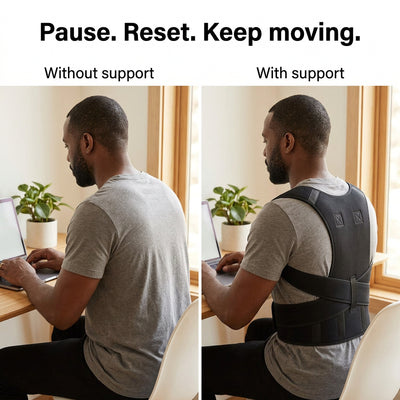
A well-fitted support gives you gentle contact that prompts you to check in with your body. When you notice it, relax your shoulders, reposition comfortably or take a movement break. Used this way, it becomes a cue that supports better habits through the day. It is different from a spinal brace prescribed and monitored by a specialist.
Our two VBOSi supports offer different coverage:
- Model 2001 provides shoulder and upper-back contact, a lighter option for desk work and study. View the shoulder posture corrector.
- Model 2002 adds a longer back panel and waist fastening for broader contact. Compare the back posture corrector.
Choose by comfortable fit and the coverage you prefer, not on the assumption that a larger support delivers stronger treatment. In a short trial of a different shoulder-blade brace during typing, researchers recorded changes in muscle activity but no significant immediate improvement in pain, fatigue or neck alignment. That is why we position correctors as awareness tools that work alongside movement and a good setup.
A sensible next-step routine
- Name what concerns you. Is it a change in shape, discomfort during a task, stiffness, fatigue or a diagnosis you already have?
- Get assessed when it matters. A new or worsening curve, persistent symptoms or unexplained height loss deserve a professional opinion. Mention any osteoporosis, fractures, injuries or surgery.
- Ask what you can safely do. A good plan explains which exercises, how much, how to progress and what to do if symptoms flare.
- Make the task easier. Keep your screen central and readable, support your feet and back, and keep your keyboard and mouse within easy reach.
- Keep moving. Build natural changes of activity into your day rather than trying to hold one ideal position.
- Add a reminder if it helps. A corrector earns its place when a gentle cue supports the routine you have already built.
For a step-by-step workday plan with gentle movements, read A practical posture routine for desk work, study and everyday movement.
Common mistakes to avoid
- Treating every rounded back as a posture failure.
- Believing promises of a complete fix in a set number of days.
- Forcing a large range of movement, or tightening a support when it becomes uncomfortable.
- Copying someone else's rehabilitation plan, a child's prescribed bracing schedule or a social-media transformation.
Follow the supplied product instructions rather than inventing a wear schedule. Remove a support if you notice irritation, tingling, numbness, restricted breathing or increased discomfort, and if you have an existing condition, check that a support suits you before trying one.
The South African everyday
A taxi or car commute, a dining-table workspace shared with the family and an evening of study can add up to a day with very little change of position. Start with simple, affordable adjustments before buying more equipment: a stable screen height, a cushion for lower-back support and a reason to stand up between tasks.
If you need an assessment, your GP (general practitioner) or a physiotherapist can identify the next step and refer you where needed. Check fees and any medical aid benefits directly with your provider.
When to see a professional
Book an assessment for a new or worsening curve, height loss, persistent pain, unexplained weight loss or symptoms that affect normal activities. Seek prompt care for sudden, severe or rapidly worsening pain, or pain with fever and feeling unwell.
Get emergency medical help for back pain with new bladder or bowel changes, numbness around the genitals or buttocks, symptoms in both legs, chest pain, severe breathing difficulty or after serious trauma.
Frequently asked questions
Can a posture corrector straighten structural kyphosis?
No. Structural curves need diagnosis and condition-specific management. A retail corrector works as an everyday awareness cue alongside movement and a comfortable setup.
Does exercise help everyone with a rounded upper back?
Exercise helps many people with strength, mobility and comfort, and supervised programmes have reduced measured curvature in some older adults. The right programme depends on the cause and the person.
Is a prescribed spinal brace the same as a retail corrector?
No. Specialist bracing is prescribed for specific conditions and monitored over time. A retail support is a comfort and awareness tool.
Should I hold my shoulders back all day?
No. Aim for comfortable support and regular changes of position rather than a rigid pose.
Can this guide tell me whether I have kyphosis?
It helps you understand the options and ask better questions. A diagnosis needs an in-person examination.
Share what you've learned
Everyday experience sharpens our research. If you have lived with a rounded upper back, worked through a routine that made a difference or have a question you would like us to investigate, tell us what you need. Please mention this guide's title so we can connect your message to the right topic. Your input helps shape future guides and the solutions we choose.
Explore more in our Posture & Movement guides.
Sources and further reading
- NHS (National Health Service), Kyphosis
- South Tees Hospitals, Kyphosis and Scheuermann's kyphosis
- Katzman and colleagues, supervised hyperkyphosis exercise trial
- Royal Osteoporosis Society, exercises to help with posture
- Slater, O'Sullivan and colleagues, "Sit up straight: time to re-evaluate"
- Scapular brace typing trial
- NHS, Back pain
- NHS, Tiredness and fatigue
Shop the solution
What we recommend for this
The practical pieces that fit the routine in this guide. Choose what fills a real gap for you.